Alphabet Tracing Worksheet Generator
Printable alphabet tracing worksheets for uppercase, lowercase, letter pairs, vowels, and common letter reversals (b vs d).
- Target Learners
- Preschool, Pre-K & Kindergarten (Ages 3–6)
- Inputs
- Presets: Paired (Aa), Uppercase (A), Lowercase (a), Vowels, Reversals
- Output Format
- Print-ready 1200+ DPI Vector PDF & Print (Letter / A4)
- Guidelines
- U.S. 3-Line (1.0″ Preschool & 0.75″ Kindergarten)
- Cost & Account
- Free • No Login
- Student Privacy
- 100% In-Browser Execution • Zero Server Tracking
🔤Alphabet Layout Mode
Alphabet Handwriting Practice
Follow the guidelines to trace uppercase and lowercase letters
Real Worksheet Output Previews
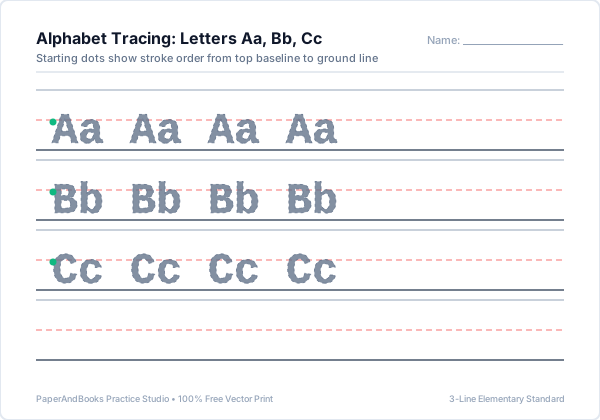
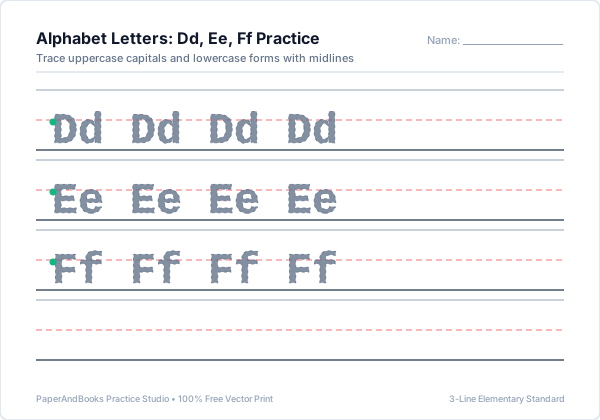
Sample vector outputs generated by Alphabet Tracing Worksheets. Razor-sharp at 1200+ DPI with standard U.S. elementary 3-line ruling.
How to Print or Save as PDF
Follow these printer settings to ensure standard elementary guidelines print at their exact calibrated physical dimensions (1.0″, 0.75″, 0.50″, or 0.375″):
- 1. Click Print / Save PDFClick the blue button above the preview window to trigger your browser's native vector print engine.
- 2. Destination SelectionChoose your physical classroom/home printer, or select "Save as PDF" to export a high-resolution file.
- 3. Paper Size & Scale 100%Select US Letter (8.5 × 11″) or A4. Set Scale to "100%" or "Actual Size"—avoid "Fit to Printable Area" to preserve exact ruling height.
- 4. Enable Background GraphicsUnder More Settings, check "Background graphics" to ensure dashed midlines and colored guide dots print with maximum contrast.
Frequently Asked Questions
Common questions about ruling specifications, classroom use, and pedagogical mechanics for Alphabet Tracing Worksheets.
Does this tool teach uppercase letters, lowercase letters, or both together?▼
You can toggle uppercase-only, lowercase-only, or paired uppercase/lowercase (Aa, Bb, Cc). Paired mode is recommended for kindergarteners learning letter correspondence.
How do top-to-bottom stroke sequence guides prevent letter drawing habits?▼
Each letter includes a green starting dot at the true anatomical origin of the stroke (top headline or midline). This stops children from starting at the baseline and drawing letters backwards.
What letter sequence is recommended for teaching letter formation?▼
Many educators begin with straight-line capitals (L, T, I, H, F, E), followed by curved capitals (C, O, Q, G), before tackling diagonal letters (M, N, V, W, X, Y, Z).
How do guideline midlines help children understand ascenders and descenders?▼
The dashed midline clearly demarcates tall ascender letters (b, d, h, k, l, t) that reach the top headline versus descenders (g, j, p, q, y) that drop below the solid baseline.
Can I print an individual target letter practice sheet or the full A-to-Z collection?▼
You can isolate any single letter for targeted remediation or generate a comprehensive full-alphabet practice pack ready for classroom printing.
Related Handwriting & Literacy Tools
Explore our complementary free elementary worksheet generators:
Develop line stability, waves, and curves before writing full alphabet letters.
Practice numeral formation alongside letter practice with starting dots.
Apply alphabet mastery directly to writing the child's own personal name.
Combine learned alphabet letters into high-frequency sight words.