Number Tracing Worksheet Generator
Printable number formation worksheets for preschool and kindergarten. Build number recognition and numeral writing fluency.
- Target Learners
- Preschool, Pre-K & Kindergarten (Ages 3–6)
- Inputs
- Presets: 0–10 Single Digits, 11–20 Teen Numbers, Numeral + Word, 1–20 Review
- Output Format
- Print-ready 1200+ DPI Vector PDF & Print (Letter / A4)
- Guidelines
- U.S. 3-Line (1.0″ Preschool & 0.75″ Kindergarten)
- Cost & Account
- Free • No Login
- Student Privacy
- 100% In-Browser Execution • Zero Server Tracking
🔢Number Groups
Number Tracing Practice (0–10)
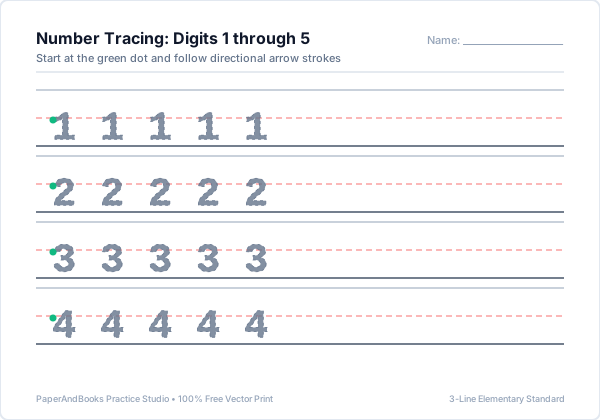
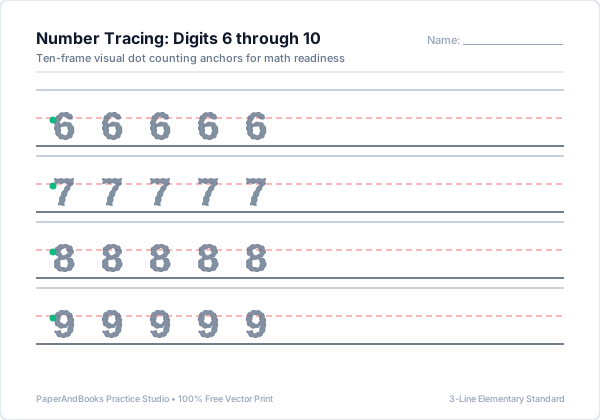
Trace each number carefully starting at the green dot
Real Worksheet Output Previews
Sample vector outputs generated by Number Tracing Worksheets. Razor-sharp at 1200+ DPI with standard U.S. elementary 3-line ruling.
How to Print or Save as PDF
Follow these printer settings to ensure standard elementary guidelines print at their exact calibrated physical dimensions (1.0″, 0.75″, 0.50″, or 0.375″):
- 1. Click Print / Save PDFClick the blue button above the preview window to trigger your browser's native vector print engine.
- 2. Destination SelectionChoose your physical classroom/home printer, or select "Save as PDF" to export a high-resolution file.
- 3. Paper Size & Scale 100%Select US Letter (8.5 × 11″) or A4. Set Scale to "100%" or "Actual Size"—avoid "Fit to Printable Area" to preserve exact ruling height.
- 4. Enable Background GraphicsUnder More Settings, check "Background graphics" to ensure dashed midlines and colored guide dots print with maximum contrast.
Frequently Asked Questions
Common questions about ruling specifications, classroom use, and pedagogical mechanics for Number Tracing Worksheets.
Why do these number worksheets include ten-frame dot counting visual anchors?▼
Ten-frames bridge handwriting with number sense. By visualizing quantities alongside numeral strokes, early learners understand both symbol formation and mathematical value simultaneously.
What is the difference between the 0–10 beginner pack and the 11–20 teen pack?▼
The 0–10 pack focuses on single-digit formation and baseline alignment. The 11–20 teen numbers pack emphasizes two-digit spatial orientation, teaching students to write the tens digit and ones digit without overlapping.
How do starting dots prevent common number reversals like 3, 5, or 7?▼
Number reversals usually occur when a child starts at the bottom or middle. Green starting dots anchor the pencil at the correct top starting point, naturally guiding the correct left-to-right curve.
Can students practice both numeral digits and written number words on the same sheet?▼
Yes. Our preset options allow pairing numerals (e.g. '3') with their spelled-out number word ('three') on standard elementary 3-line ruling.
What line ruling is best suited for early childhood number formation?▼
We recommend 0.75″ Kindergarten ruling for preschool and kindergarten learners to ensure generous vertical room for curved numerals like 2, 3, 5, 8, and 9.
Related Handwriting & Literacy Tools
Explore our complementary free elementary worksheet generators:
Practice uppercase and lowercase letter formation with starting dots.
Master straight strokes, arcs, and loops before practicing curved numerals.
Print blank lined math and handwriting paper with customizable margins.
Create personalized name tracing worksheets for early childhood learners.